India, New Zealand sign MoU for civil aviation cooperation
Union Minister for Civil Aviation, Jyotiraditya Scindia, remarked that the signed MoU has unlocked opportunities for the expansion of air transportation links between India and New Zealand. In a significant development, the governments of India and New Zealand joined forces to formally establish a Memorandum of Understanding (MoU) aimed at enhancing collaboration in the realm of civil aviation. The agreement encompasses various aspects such as the establishment of new flight routes, the sharing of code services, traffic rights, and capacity allotments.
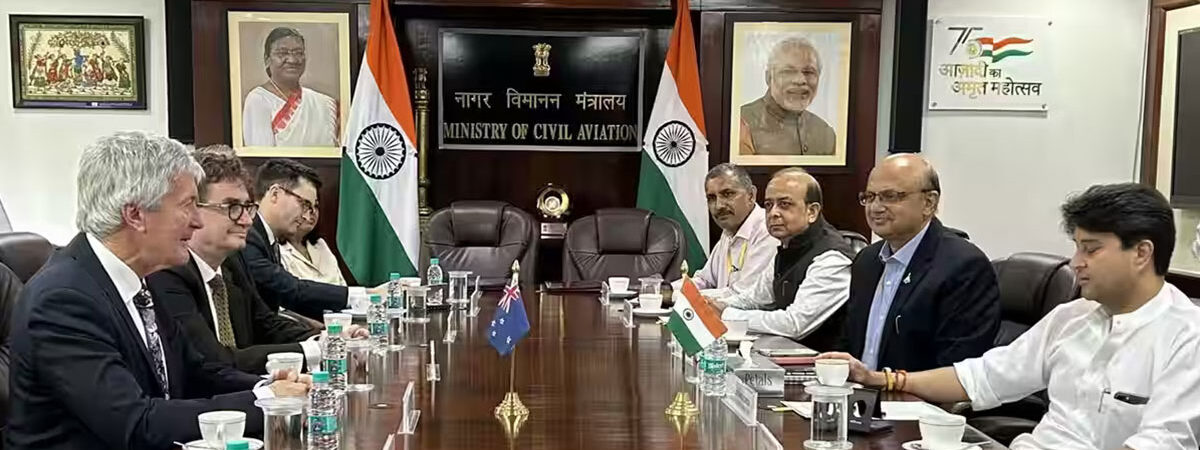
The MoU was ceremoniously signed by Rajiv Bansal, the Secretary of the Ministry of Civil Aviation, and David Pine, the High Commissioner of New Zealand, in the esteemed presence of India’s Civil Aviation Minister Jyotiraditya M Scindia and Damien O’ Connor, a minister in New Zealand’s government overseeing trade, export growth, biosecurity, and other portfolios.
Scindia highlighted the pivotal significance of the day, underlining its importance in fostering civil aviation services between India and New Zealand. The MoU, he mentioned, serves as a catalyst for further advancements in air transport between the two nations. The implementation of an open sky policy, an increase in points of call, and the expansion of intermediate points all feature prominently in the signed agreement, according to Scindia.
The terms of the MoU delineate that designated airlines from New Zealand possess the prerogative to operate a multitude of services utilizing various aircraft types, while enjoying third and fourth freedom traffic rights for travel to and from six specific points in India—namely, New Delhi, Mumbai, Bengaluru, Chennai, Hyderabad, and Kolkata.
This recent development builds upon the Air Services Agreement inked between the two nations on May 1, 2016, in Auckland. Both the Indian and New Zealand governments took the initiative to evaluate existing arrangements governing air services between the two countries.
Furthermore, the MoU stipulates that airlines designated by either party are authorized to conduct a diverse array of cargo services using different aircraft types, accompanied by third, fourth, and fifth freedom traffic rights. These rights extend from any points in the territory of one party to any intermediate point(s) and onward to any destination point(s), irrespective of the specified points listed in the Route Schedule.