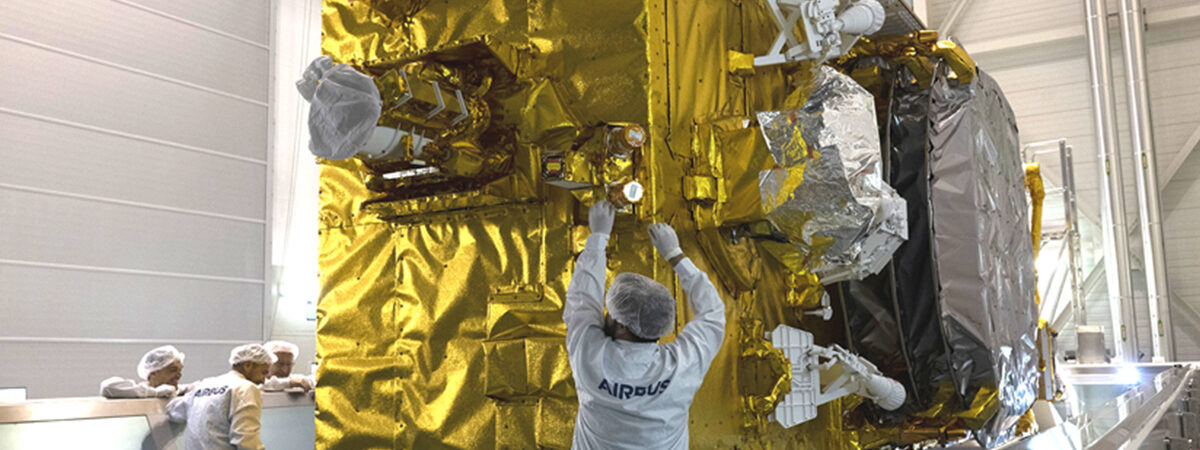
Arabsat Badr-8 successfully launched: featuring Airbus’ innovative optical communications payload TELEO
From Cape Canaveral in Florida, the Arabsat Badr-8 communications satellite, built by Airbus, has safely launched into orbit. Badr-8, based on Airbus’ most recent geostationary Eurostar Neo satellite, will offer connection to consumers in central Asia, the Middle East, Africa, and Europe.
The spaceship also includes a first-of-its-kind innovation from Airbus called TELEO, which enables gigabit-speed optical communications between space and the ground. Airbus is using the TELEO demonstrator payload to further the development of a new generation of optical communications technology for use in space by enabling very high capacity optical feeder link communications.
Jean Marc Nasr, Head of Space Systems said: “Marking our third successful launch of the Eurostar Neo series and our eighth spacecraft built for Arabsat, Badr-8, equipped with the very innovative TELEO payload, is the latest major milestone for our telecoms business. Featuring increased payload capacity and more efficient power and thermal control systems, Badr-8 will replace and increase Arabsat’s capacity.”
After a successful launch and separation, Badr-8 is now using its electric propulsion system to travel 36,000 kilometers to geostationary orbit. After then, the satellite will spend some time in geostationary orbit undergoing extensive testing before going into full operation. The satellite has a 4.5-ton launch mass and 17.8 kW of power, and it is intended to stay in orbit for 15 years. The extremely dependable geostationary communication satellites from Airbus have been in orbit for more than 1,300 years.
Airbus’ Eurostar Neo platform has been developed in the frame of the European Space Agency’s (ESA) Partnership Projects, together with the French space agency CNES, and strongly supported by the UK Space Agency and other agencies across Europe. CNES provided assistance in the development of the TELEO demonstration payload.